

The card proof looks clean on the desk. Then someone slides it into an envelope, the corners pinch, or the flap drops over a logo nobody mentioned, and now we are talking about a reprint. That is a bad time to start the envelope brief. For greeting card envelopes, put the closed size of the card in the first email, plus how you want the card to sit, the flap, and the colour.
HangPeng prints custom greeting cards in Yiwu, and the envelope is part of that brief, not a detail to settle after the card is already approved. Paper, finishes and the card spec sheet live in our spec guide to custom greeting card printing. Bleed, the fold and the safe area live in our note on custom greeting card artwork. This article stays on the envelope.
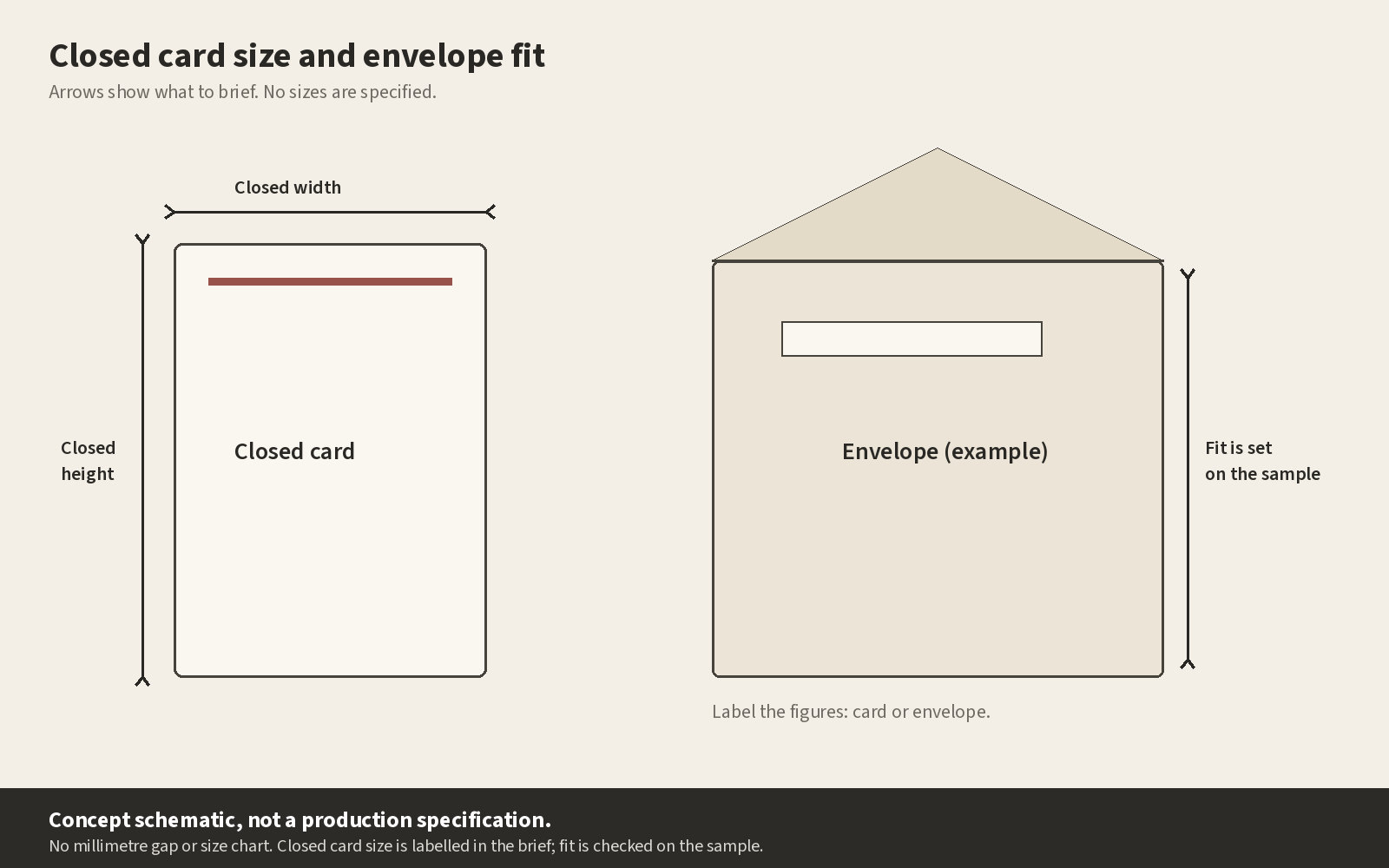
Start with the closed size of the card
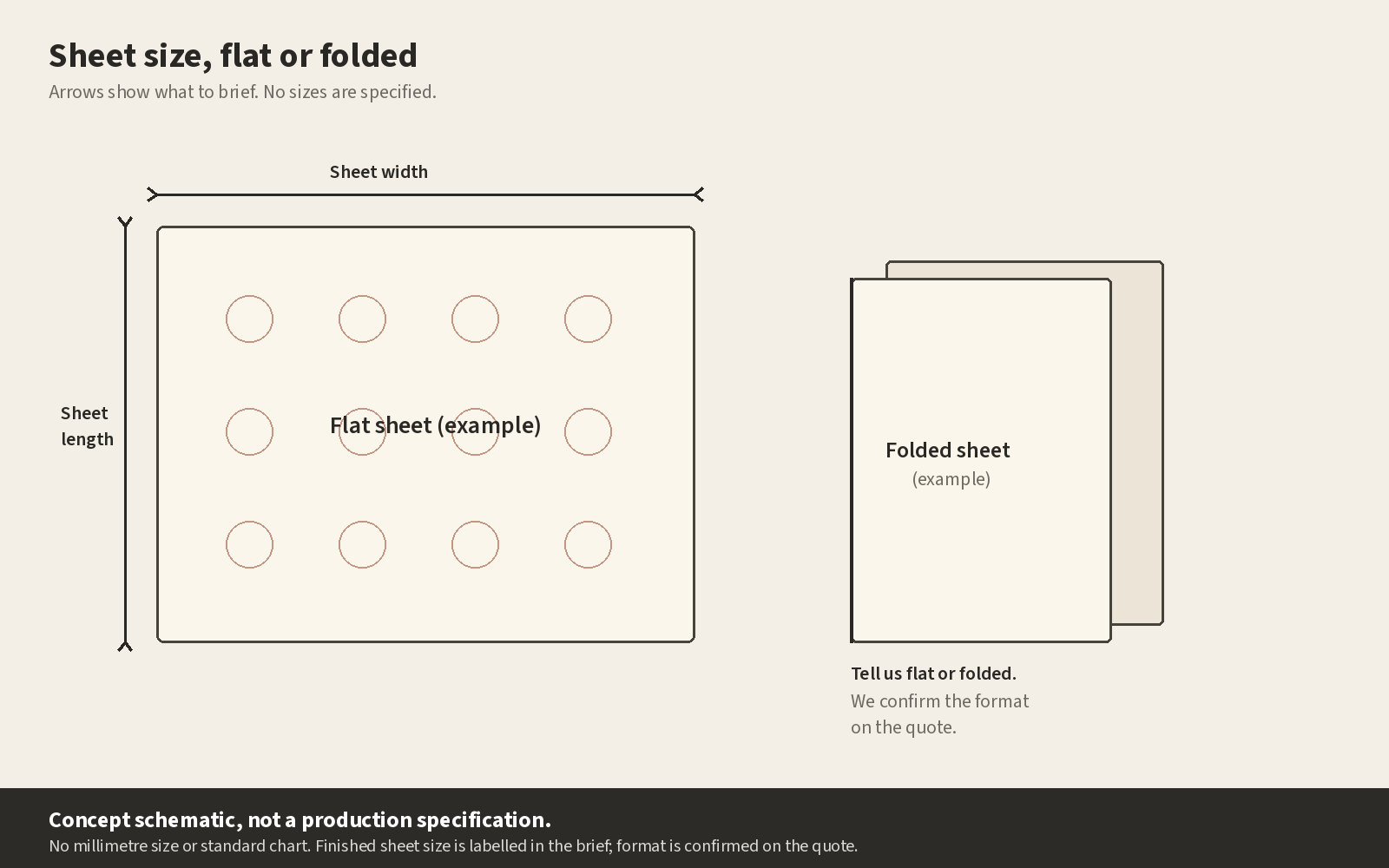
We still open emails that list one size and stop there. The first reply is almost always the same: is that the card, closed, or the envelope? A bare trio of numbers is not enough. A size name on its own is not enough either. Write the closed width and height of the card, and label those figures as the card. If you already have a target for the envelope, write that on a second line and label it as the envelope.
Keep one unit for the whole email, cm or inches, and put the unit next to the figures. We have had a 5 x 7 that was inches, read as centimetres, and the first sample looked tiny before anyone had even opened the artwork. “The usual envelope” fails here. So does “a standard fit.” Those words change meaning between an office and a factory floor.
If you already have a card and an envelope that fit the way you like, send both. Or photograph them together, closed, then with the flap lifted, and jot the two sizes on the photos. We would rather work from a pair you already use than guess a gap around the card.
This page does not publish an envelope size chart. There is nothing here to match an “A7 envelope” request against unless you also send the card’s closed size, and tell us how you measured it. We’ll set the fit on the quote and check it on the sample.
A card that is wider than it is tall, or taller than it is wide, still needs those two closed figures. The orientation only helps if the numbers are labelled.
How the card sits in the envelope
Fit is not only “does it go in.” Some buyers want a little room so the card slides in quickly at a packing table. Some want a closer fit that feels tighter in the hand. Those two jobs are not the same. If your team will be packing in a hurry, say so. A tight corner that looks neat on one sample can slow a packing line once the quantity goes up, and then everyone is annoyed.
Watch the corners and the spine. A card measured before it was folded often sits differently once the fold has a thickness. If you already know the card is thick, or a finish adds a little height at the fold, put that next to the closed size. We would rather flag a tight corner on the quote than after a sample has been made.
If the order has more than one card size, list each closed size with its own envelope. Don’t assume one envelope works for every card in the line. We have been sent a single envelope size for three cards, and two of them did not sit right.
A 3D pop-up card is a different structure, and the envelope brief changes with it. If that card has to travel in its envelope, pack the sample that way. See whether the piece inside sits the way you want, or whether it gets crushed at the flap. We’ll confirm that construction on the quote. The pop-up product itself is on our 3D pop-up greeting cards page. This brief does not retell how the pop-up is built.
Flap, colour, and a liner if you want one
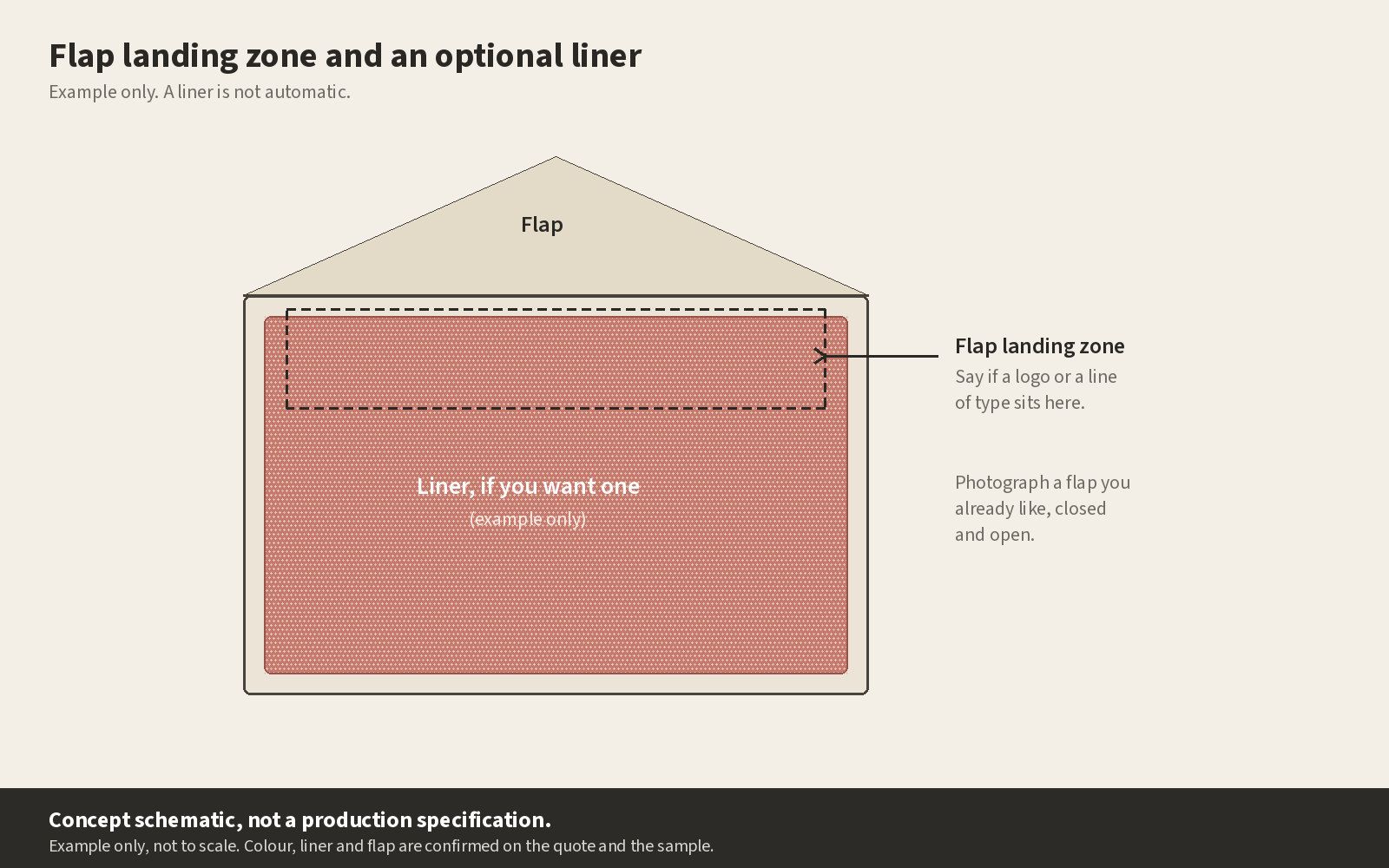
The flap is part of the brief. Say whether a logo, an address panel, or a line of type sits where the flap will land when the envelope is closed. We have had artwork that looked fine on an open envelope, then the flap covered the mark the buyer cared about. If you already like a flap on an envelope you have, photograph it closed and open, and tell us to follow it. Style names travel badly. We are not posting a flap catalogue on this page.
Tell us the colour you want, or send a swatch. If you already have a card line with a matching envelope, send one of each. “Match the card” only works if we can see the card, or a printed colour reference. A screen shot of a red envelope is a starting point, not a finished colour instruction.
If you want a printed liner, say so in the first email, and send the artwork or the direction for it. We’ll confirm on the quote whether your job includes a liner. This page does not treat liners as automatic, and it does not quote a liner grade.
If the envelope itself is printed, send that file with the card files. Mark which panel is the flap, because we have had files where the flap was the back, and the logo landed in the wrong place. The artwork article covers bleed and the safe area for the card. We’ll set the envelope details on the proof. Do not leave the envelope file until after the card is signed off if the two have to sit together.
Check the sample with the card in the envelope
For an ordinary custom card job we usually quote a custom sample in 7 to 10 days and bulk production in 15 to 20 days after approval, depending on quantity. A construction that sits outside the ordinary run may need a different window, so we’ll confirm both timings on the quote once the brief is clear. Prices are EXW Yiwu.
A plain stock sample, if we have a card and envelope close enough to look at, goes out free, freight collect. A printed custom sample is quoted. A free stock pair is not a custom-size sample, and it is not a printed envelope.
When the sample arrives, put the card in the envelope and close the flap. See whether the corners catch, and whether the card slides out more easily than you want. Hold the closed envelope next to the card and look at the colour. Lift the flap and check that it lands where you expected, especially if a logo or a line of type sits on that panel. If you mail these cards, use the sample, with the card in it, for that check as well.
If it is tight, or loose, or sitting wrong, fix it on the sample. Catching it after bulk has started costs more. It also eats the calendar, which is usually the part people remember.
What to send for a greeting card envelope brief
Custom greeting cards start at 5,000 pieces per order. That minimum applies to the card job this envelope belongs to.
Send us:
- Closed width and height of the card, with units, labelled as the card
- Envelope size if you already have a target, labelled as the envelope, or a sample pair you want us to follow
- How the card sits: a little room to pack, or a closer fit
- Flap notes, and a photo of a flap you like if you have one
- Envelope colour, or a swatch, and a liner yes or no if you already know
- Envelope artwork if the envelope is printed, with the flap marked
- Card artwork, or a brand direction, and the quantity and the date you need the goods in hand
تواصل معنا عبر البريد الإلكتروني aaron@yc-gift.com أو pengtaolou97@gmail.com، أو عبر واتساب على الرقم +86 130 5899 5000، أو استخدم موقعنا الإلكتروني. صفحة الاتصال. You can also look at our festival greeting cards and بطاقات تهنئة للشركات if you want a sense of the other card work we do. This article stays on the envelope brief itself.
التعليمات
What is the MOQ for custom greeting cards, including the envelopes?
5,000 pieces. That is our greeting card minimum, and the envelope is part of that card job.
Do I have to send an envelope size, or is the closed card size enough?
Send the closed size of the card, labelled as the card. If you already have an envelope size or a pair that fits the way you like, send that too. A size name on its own is not enough. We’ll set the fit on the quote and check it on the sample.
Can you print the envelope and add a liner?
Yes, when that is part of the brief. Send the envelope artwork with the flap marked, and say whether you want a printed liner. We’ll confirm both on the quote. Liners are not automatic on every card job.
How long does a custom greeting card order take if it includes envelopes?
We’ll confirm the sample and bulk timing on the quote once the card and the envelope brief are agreed. An ordinary custom card job is often 7 to 10 days for a sample and 15 to 20 days for bulk after approval, depending on quantity. Don’t treat those figures as a promise until this job is agreed.
Do you send a blank card and envelope I can test?
Yes, with limits. If we have a plain stock card and envelope close enough in size to be worth looking at, we send them at no charge and you pay the freight. A printed custom sample is a quoted item, not a free one. Put the card in the envelope when the sample arrives. That is the check that counts.