

The box looks fine on the table, empty and square. Then the bottle rocks, because the brief had an outside size and a neat render, and nothing about how the product actually sits. For gift box inserts, put the insert type, the product’s length, width, height and weight, and a photo of the real item into the first email, before a tray is cut.
HangPeng makes paper trays, sponge inserts and raffia fills in-house in Yiwu, and we work from that kind of brief. The render still helps. It does not replace the product.
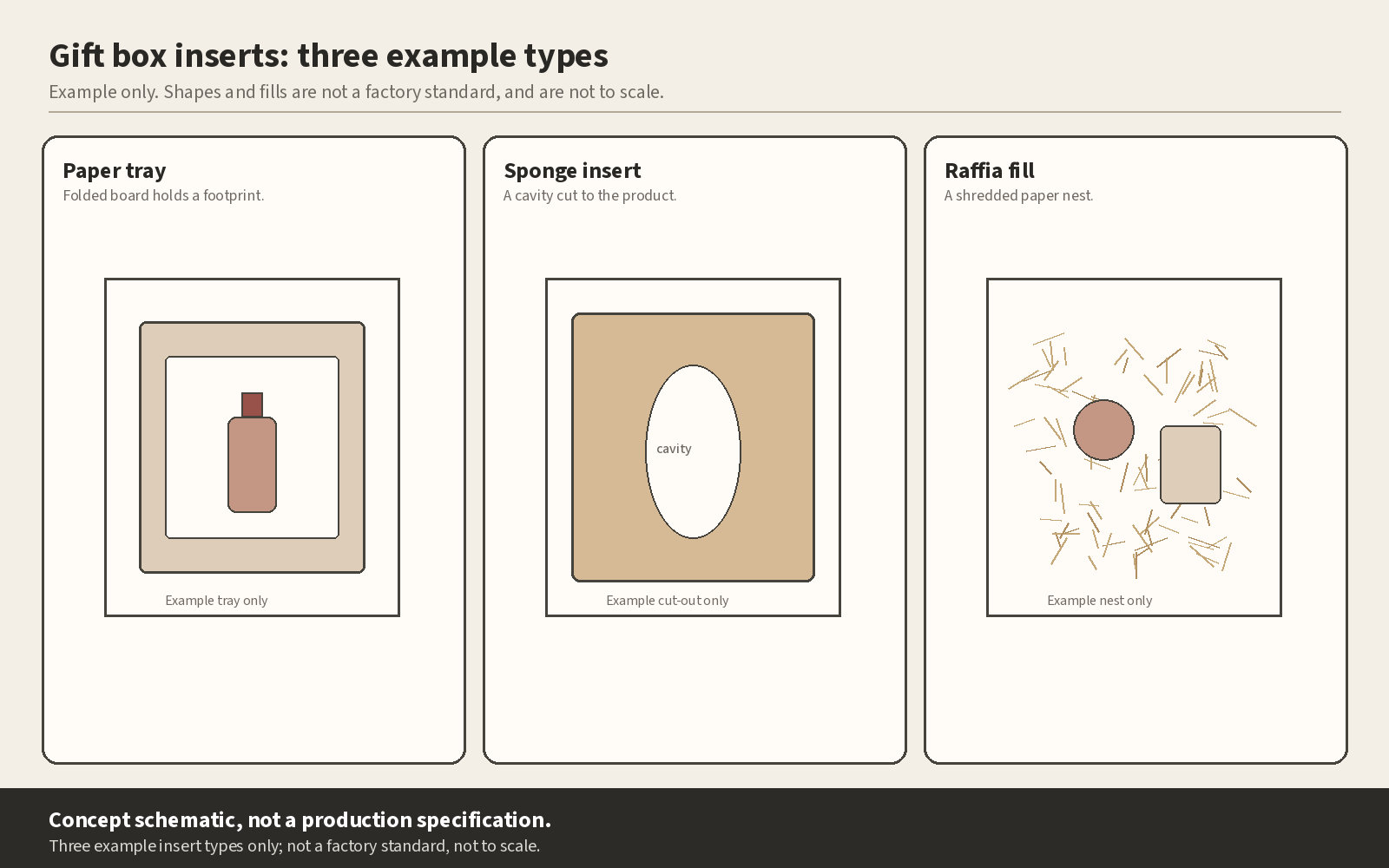
Pick the insert, or skip ahead if you already know
If you already know you want a paper tray, a sponge cut-out, or raffia, don’t linger here. Put that word in the email, add the sizes, and attach a photo of the product.
Not sure yet? Start with the product, not with the box. We can’t pick an insert from a lid-and-base sketch alone. We need to know whether the bottle stands up, and whether the cap stays on. A tray is often enough when the item has a flat base you can measure and you want the pack to stay paper. If the piece is a heavy bottle or a bit of glass that has to stay put, we usually cut sponge. Mixed loose contents are where raffia earns its keep, because a tight cavity would need recutting every time the assortment changes.
We already listed these three on our comparison of rigid and folding gift boxes, which covers the outer box. If you still need to pick lid-and-base or a folding structure, use that comparison first. If the box is a one-piece fold, say so; the opening changes how the product goes in, which we covered in our note on one-piece gift boxes.
One insert per brief is enough to start. Mixing a tray and raffia in the same box is a different job. Mention it if that is what you want, and we will look at it on the sample.
A paper tray holds a footprint
Some buyers say tray, some say card insert, some say divider. We only need to know whether a folded paper structure is what holds the product. The board is cut, folded, and dropped into the box. It cups the base. It does not hug the sides the way a sponge cavity does.
That is often enough for a bottle, a jar, a folded garment, or two or three pieces with a wall between them, provided the sizes are honest. Want the pack to stay paper? This is usually where we start.
Tray board is quoted against the product you send, then checked on the sample. Please don’t lift a range from an outer-box page and drop it on the insert; those numbers were written for the wrap or the folding board, not for a tray.
If you already have a tray you like, take a picture of it sitting in the box, then take it out and photograph it again. A name is optional. “It holds the bottle at the base and leaves the neck free” is more useful than a style label we may not share.
A sponge insert holds a shape
Buyers also call this foam. On our floor the block is cut to the object in front of us, not to a drawing that is a bit optimistic.
Glass is the usual headache. A supplier drawing is often a few millimetres away from the bottle that actually arrives. Cut the cavity to the drawing and someone ends up pushing the bottle in. If you can ship us the product, do that. If you can’t, measure it yourself, cap on if the cap stays on in the pack, and say whether it stands or lies down. Those are not the same hole.
The quote will name the sponge grade we plan to use; the sample is the check. And if the item ships with a sleeve or a hang-tag still attached, measure that packed lump, not the bare bottle.
Sometimes a buyer already has a sponge from an earlier order and wants us to follow it. Fine. Photograph it with the product in, then with the product out, and say you want us to follow that shape. We will still cut our own sample and check the fit. A photo does not tell us the hidden grade, and we will not pretend it does.
Raffia is a nest, not a cavity
Raffia, in this brief, is the shredded paper that sits in the box and around the goods. We use it when the contents are mixed or loose. A tight tray would have to be recut every time someone swaps a jar for a tin.
It still belongs in the first email. Write that you want raffia, then list what actually goes in: how many pieces, which one is largest, and the weight. One jar in a full-looking nest can look lost once you add two more items. Or the fill sits up so high the lid will not close. We sort that out on the sample. Send the real contents if you can; if you can’t, send sizes and a photo of how you pack it now.
A lifestyle photo is not a fill spec. If you care about the colour, say so in the email. If you don’t, the quote will name what we plan to use.
Measure the product, then talk about the box
Put the product’s length, width and height in the quote request. If it already has its own pack, give us those sizes as well. Then the weight, then which way it sits, then a straight-on photo. A ruler in the frame helps. An overhead beauty shot almost never gives a usable height.
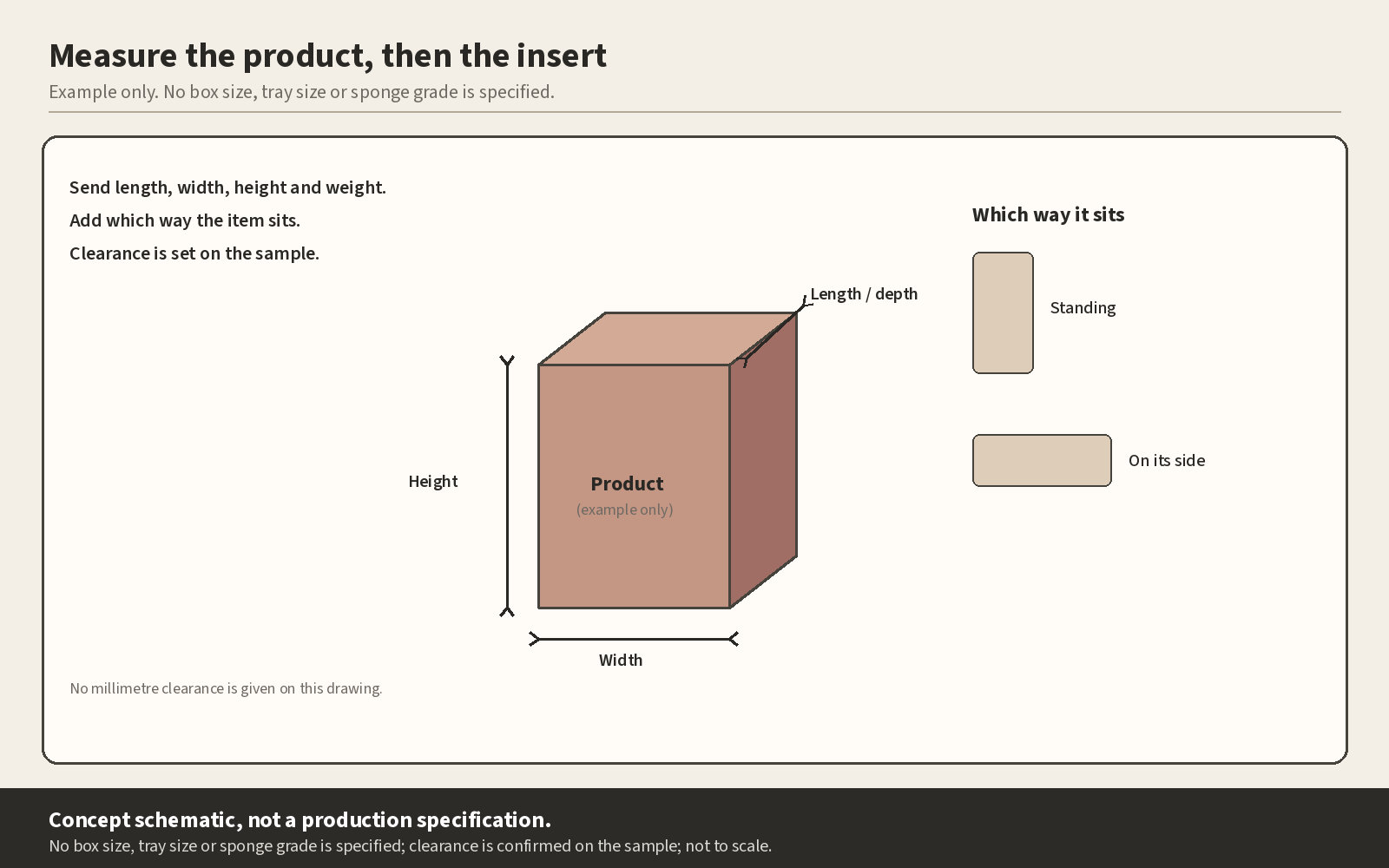
Leave a little space around the product. The amount changes with the item, with the insert, and with the way the lid opens, so we only lock the clearance once the sample is packed with the real piece.
If a shelf or a shipper you already use caps the outside of the box, write that limit in the same email. Then we can say, on the quote, whether this insert and this product actually fit.
Tissue, a ribbon, a small card left in the box: mention those if they stay with the product. They add bulk. They are not a fourth in-house insert type in this article.
Check the sample with the real product
For an ordinary gift box we usually quote a custom sample in 7 to 10 days and bulk production in 15 to 20 days after approval, depending on quantity. An insert may need a different window, so we’ll confirm both timings on the quote once the brief is clear. Prices are EXW Yiwu.
When the sample lands, pack the real product. Paper stand-ins hide the problems. For a tray or a sponge, drop the item in and take it out a few times. Does it go in without a shove? Does it stay put when you tilt the box? If this pack has to travel, put one sample into the same shipper you will use and see what shifts. For raffia, pack the real assortment, close the lid, and look. The fill may sit too high, or it may leave a gap around the largest piece.
Tight, loose, or just awkward: change it on the sample. Waiting until bulk has started is a more expensive way to learn the same thing.
What to send for a custom gift box insert quote
Custom gift boxes start at 1,000 pieces per order, and that minimum applies when the order includes an insert. The sample fee on a gift box is refunded once that order reaches 1,000 pieces.
Send us:
- The insert type: paper tray, sponge, or raffia, or “not sure” plus a photo of a pack you want to follow
- Length, width, height and weight of the product, plus a photo
- Which way the product sits in the box
- Any limit on the overall box size
- Whether the box is a rigid lid-and-base, a folding box, or a one-piece structure, if you already know
- Quantity and the date you need the goods in hand
Email aaron@yc-gift.com or pengtaolou97@gmail.com, WhatsApp +86 130 5899 5000, or use our contact page. See also how we build perfume boxes and garment boxes, or browse the box range.
FAQ
What insert types do you make in-house?
Paper trays and dividers, sponge inserts cut to the product, and raffia fill. If you have another structure in mind, send a photo and we’ll say on the quote whether we can follow it.
What if I only have the product and no insert to copy?
Start there. Sizes, weight, a product photo, and a short note on whether you want a tray, a sponge, or raffia are enough to get a quote moving. If you once liked a pack you saw in a shop or in a photo, send that picture too, with the product in the box if you can get that shot.