

Every December someone sends me the same photo. A gift bag on a shop floor. One handle still in the customer’s hand. A bottle of wine in pieces on the tiles.
People blame the paper. Most of the time the paper is fine. The handle patch let go, the glue on the base gave up, or the bag was the wrong size for what went in it.
I run the paper bag line at HangPeng in Yiwu. Here’s where gift bags actually break, and what we change on the order so yours don’t.
Start With What Goes Inside
Before anyone talks about paper weight, I ask three questions.
What goes in the bag? How heavy is it? How does the customer carry it?
A candle and a bottle of whisky can weigh about the same. They load a bag in completely different ways. The candle sits low and still. The bottle is tall, the weight sits high, and it swings every time the customer takes a step. Each swing yanks on the handles.
So send us the product, or at least its size and weight. A phone photo next to a tape measure is fine. That tells us more than any number on a quote sheet.
Where Handles Fail
The patch inside the top fold
Twisted paper handles are glued to a strip of paper inside the top fold. When a handle rips out, look at that strip first. Usually it’s too short, too thin, or the glue only caught part of it.
For heavier fills we use a wider patch and glue across the whole thing, not in dots. Then we pull a few bags off the running line and load them with weight, not just the first sample off the bench. Ask any supplier to do the same.
Holes too close to an edge
If the handle ends sit close to the top edge, the paper tears straight up. If they sit close to the side fold, the stress runs into the crease and splits it. Ask your factory to mark the handle positions on the dieline. Then check that they sit well clear of both.
The wrong handle for the job
Each handle type has a place.
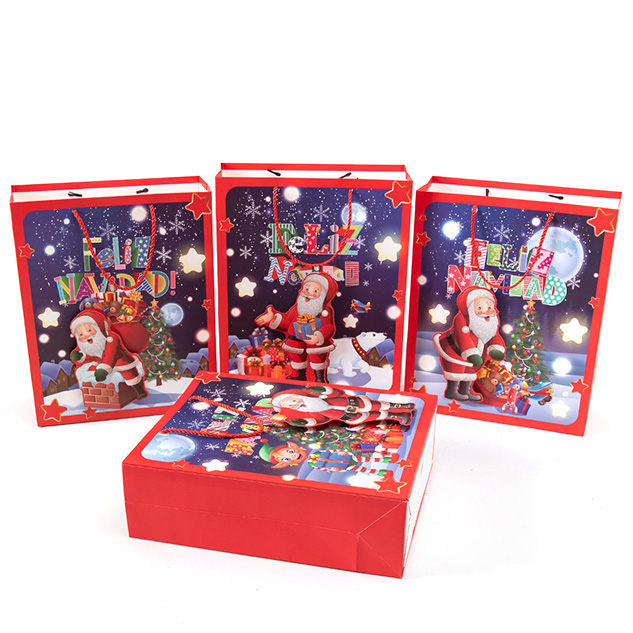
Twisted paper rope. The everyday choice. Cheap, strong enough for most gifts. On our Christmas bags we use a thick twisted rope because people carry wine, food baskets and big toy sets in them.
Cotton rope. Softer in the hand and looks more upmarket. Ask how the ends are anchored.
Satin ribbon. Looks lovely in a boutique. Ribbon stretches and slips, so it needs a solid anchor. Keep it for lighter fills.
Die-cut hole. No extra parts, very clean look. But the hole is a weak spot cut into the panel. Fine for a scarf in tissue. Not for a bottle.
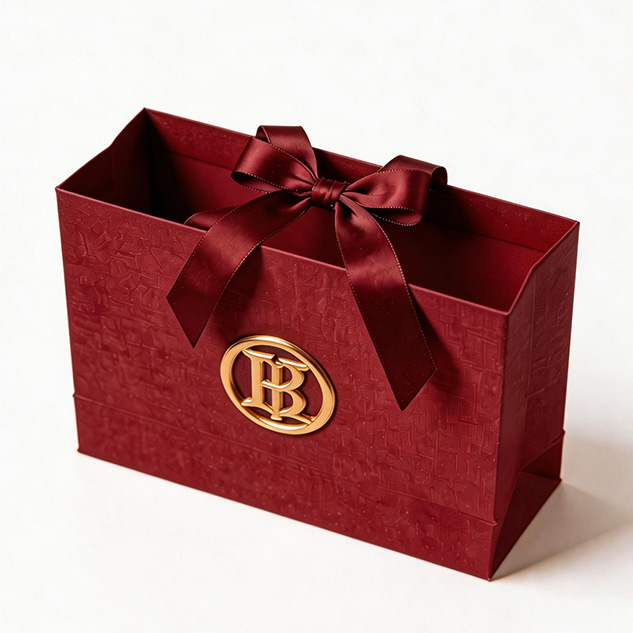
Heavy board changes the rules. Our luxury clothing bag uses 400gsm embossed paperboard with folded paper handles built into the bag. No rope at all. It works because the board is stiff enough to carry the load itself.
Where Bottoms Fail
The base sags like a hammock
Put something heavy in a bag with a soft base and the bottom bows. The glued flaps underneath start peeling. Then one corner pops.
A reinforced bottom fixes most of this. For heavy or pointed items, ask for a card board in the base as well. It spreads the weight across the whole floor of the bag instead of the middle.
The bag is too big
Buyers love a roomy bag. Roomy is a problem. Extra space lets the product slide and slam into the corners when the bag swings. Corners crack first.
Size the bag to the product plus its wrapping, not plus a safety margin. Our standard Christmas and birthday gift bags come in three sizes: 18 × 10 × 23 cm, 26 × 10 × 32 cm, and 30 × 12 × 41.5 cm. The medium is the one we list for a wine box or flowers. Custom sizes work too, and we’d rather make the right size than see a 250 ml jar rattle around in a large bag.
Damp and cold
Paper hates water. Our standard paper bags are durable, but they are not waterproof. A chilled bottle sweats in a warm shop. The base soaks up the water and loses strength fast.
If your customer carries cold wine or chilled food, tell us. We’ll add a liner or use a waterproof-coated option.
Humidity counts too. Sea freight takes 25 to 35 days. Bags sit in a container across the equator before they reach your shelf. Give the glue time to cure before the bags go flat into cartons. Tell us where the goods are heading so we pack for it.
Paper Weight Matters, But It Isn’t Magic
Our gift bags run from 120 to 250 gsm, in kraft, white card or textured paper. Wine bags start at 180 gsm. Multi-bottle bags use 180 to 250 gsm plus an extra-thick gusset and reinforced corners, with optional dividers so the bottles don’t knock together.
Here’s the catch. Thicker paper won’t save a bad handle patch. It won’t fix a bag that’s too big. And past a point it only adds cost and freight weight.
Tell us the fill weight and how the bag gets used. We’ll pick the paper inside that range that does the job. That beats choosing the heaviest number on the list and hoping.
What to Send Your Factory
Copy this into your next inquiry:
Product size and weight, with a photo
How it’s carried: shop to car, or a long walk at an event
Destination country and the season it sells in
Handle you prefer, and how premium it has to feel
Quantity per design
The date it has to be on your shelf
With that list, a factory can quote the right bag the first time. Without it, you get a guess.
MOQ, Samples and Timing
Our custom printed gift bags start at 1,000 pieces per design. Stock designs start at 300 pieces per design, and you can mix designs to reach it. That suits a shop that wants Santa, snowmen and reindeer on the same shelf.
Get a sample first. A custom sample takes 7–10 days, and we refund the sample fee once your order reaches 3,000 pieces. Load the sample with your real product and walk around with it. Swing it. Put it down hard. That five-minute test tells you more than any spec sheet.
Custom printed bags take 15–20 days after sample approval, depending on quantity. Then add freight.
For Christmas, work backwards. If you want stock in October, production starts in July. Late orders hit paper shortages and full lines. Every year someone learns this the hard way.
One Last Thing
If a bag has failed on you, send us the photo. Show us where it tore: the handle, the patch, a corner, the base. We’ll tell you what went wrong and what we’d change. No charge, no obligation. At HangPeng we’d much rather fix it on paper than on your shop floor.